
Meet Council Member Robinson

Doria Robinson is a third-generation resident of Richmond, California, a longtime food and climate justice leader, urban farmer, nonprofit executive, and public servant. She has served as Executive Director of Urban Tilth since 2008, helping to grow the Richmond-based organization into a significant community institution focused on building a more just and sustainable local food system. The California Strategic Growth Council describes Urban Tilth’s work as educating, training, and employing community members to grow food and strengthen access to healthy food, while operating more than half a dozen school and community gardens, including the North Richmond Farm.
Robinson’s connection to land, food, and cooperative economics began long before her professional career. Raised in a strong church community where her grandfather served as minister, she spent weekends and summers at the Apostolic Temple of Truth’s 350-acre ranch in Fairfield, California. It was there that she learned some of her earliest and most enduring lessons about cooperative economics, land stewardship, collective responsibility, and the importance of building community wealth. Her experience on the ranch helped shape a philosophy that continues to inform her work today: communities should have the power to own, steward, and benefit from the land, institutions, businesses, and resources that sustain them. Her upbringing and formative experience on the church ranch are also documented in her official California State Board of Food and Agriculture biography.
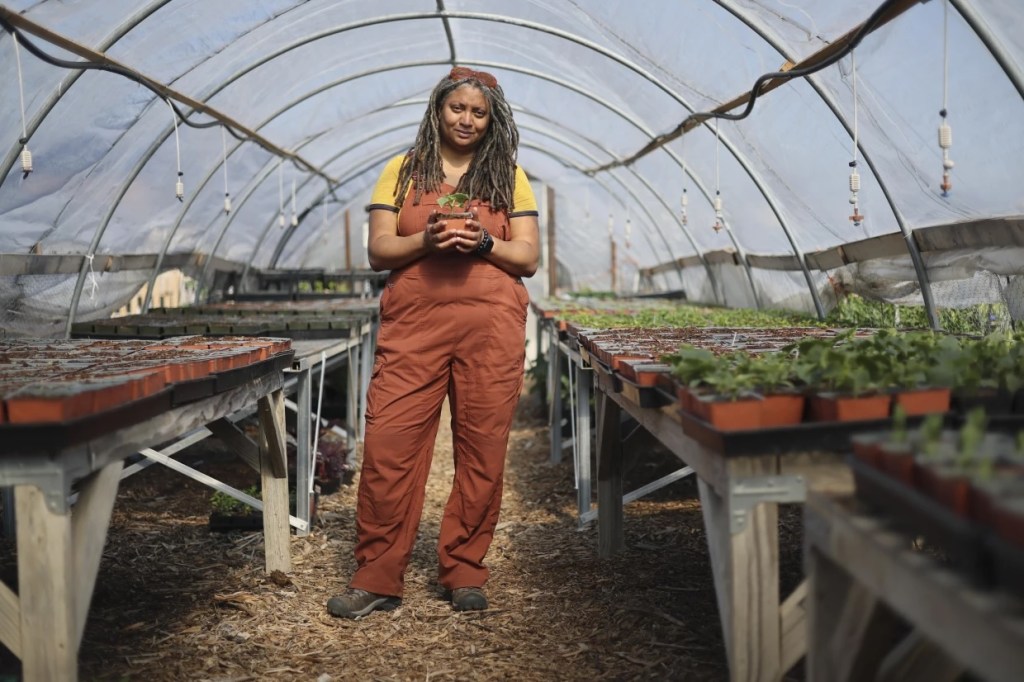
While attending Hampshire College in Western Massachusetts, Robinson worked on organic farms and deepened her commitment to sustainable agriculture and food justice. After college, she continued working throughout the food system, gaining experience that ranged from cooperative retail to large-scale organic produce distribution. She worked at Mixed Nuts Food Co-op and later at Veritable Vegetable, a women-owned organic produce distributor, where she spent three years working the graveyard shift—driving forklifts, receiving and packing produce in coolers and freezers, and loading and unloading trucks arriving from farms throughout California. She later managed the produce department at Real Food Company. These experiences gave Robinson a firsthand understanding of both the physical labor and the complex systems of production, aggregation, distribution, retail, and logistics required to build a functioning food economy. She is also a Certified Permaculture Designer. Her work with Mixed Nuts Food Co-op, Veritable Vegetable, Real Food Company, organic farms in Massachusetts, and her permaculture certification are documented by the California Department of Food and Agriculture.
Before returning fully to community-based work, Robinson spent four years working in San Francisco’s technology and advertising sector, including positions at USWeb/CKS, Shockwave and Macromedia. Beginning as an intern, she advanced into campaign management and worked on national advertising campaigns for major clients, including Lexus and Apple. The experience strengthened her skills in communications, marketing, project management, skills she later brought to nonprofit leadership, fundraising, organizational development, and public service.
Building Urban Tilth
Since becoming Executive Director of Urban Tilth, Robinson has helped transform the organization from a small, volunteer-driven effort into a major community-based nonprofit focused on food justice, urban agriculture, environmental stewardship, youth development, workforce training, and community power.
Under her leadership, Urban Tilth has developed a network of farms, gardens, food-distribution programs, youth and adult education programs, environmental restoration initiatives, and workforce-development opportunities across Richmond, North Richmond, and West Contra Costa County. The organization operates multiple school and community gardens and has become particularly known for the development of the North Richmond Farm. State sources recognize Urban Tilth’s model of educating, training, and hiring local residents to grow food for their communities.
Robinson led the development of Urban Tilth’s North Richmond Farm beginning in 2014. The farm has since grown into a roughly 10-acre community farm and educational campus designed not simply to produce food, but to serve as a community resource for agricultural education, youth development, environmental stewardship, workforce training, and community gathering.
In 2016, Robinson also relaunched Urban Tilth’s Farm to Table Community Supported Agriculture program. Originally established by the Richmond Community Foundation and later entrusted to Urban Tilth with approximately 25 members, the program expanded dramatically under Urban Tilth’s leadership. The California State Board of Food and Agriculture’s biography of Robinson documents the CSA’s growth to approximately 440 West Contra Costa County families receiving hyper-local and sustainably grown produce each week.
Urban Tilth’s food-distribution model also supports a network of small regional farms, including family-owned, women-led, and BIPOC farming operations, helping connect local food access with the economic survival of small farmers.
Today, Robinson oversees a multimillion-dollar nonprofit organization and is responsible for organizational strategy, fundraising, financial stewardship, program development, partnerships, personnel, and long-term sustainability. Public IRS filings demonstrate the scale of Urban Tilth’s growth: the organization reported more than $27 million in total assets for fiscal year 2023.
For Robinson, however, Urban Tilth’s growth is not simply about building a larger nonprofit. It is about demonstrating what becomes possible when historically disinvested communities gain greater control over land, food, jobs, environmental resources, and economic opportunity.

Building Community Wealth
Robinson also co-founded Cooperation Richmond, a nonprofit cooperative developer created to support worker- and community-owned enterprises. Cooperation Richmond was designed as a hub for cooperative incubation, education, training, mentorship, technical assistance, and access to capital.
The effort reflects Robinson’s longstanding belief in cooperative economics and community ownership. Rather than focusing solely on bringing outside investment into low-income communities, the model seeks to build institutions and businesses that allow residents themselves to own assets, create jobs, circulate wealth locally, and participate directly in the economic future of their neighborhoods. Robinson’s role as a co-founder of Cooperation Richmond is also documented by the California Department of Food and Agriculture.
Statewide Agricultural Leadership
In 2022, Governor Gavin Newsom appointed Robinson to the California State Board of Food and Agriculture. The appointment was historic: state sources identify Robinson as both the first urban agriculture representative and the first Black woman to serve on the Board.
The Board advises California’s Governor and Secretary of Food and Agriculture on issues affecting farmers, ranchers, agricultural communities, and the state’s food system. Robinson continues to serve as an Agricultural Industry Member, with her current term extending through January 2028.
Her work on the Board has helped bring urban agriculture, food access, racial and economic equity, small-farm viability, land access, and community-based agriculture more directly into statewide agricultural policy conversations.
Robinson played a leadership role in California’s multi-year effort to establish a definition of regenerative agriculture for use in state policies and programs. She chaired the Board’s Regenerative Agriculture Committee and participated in the state’s Regenerative Agriculture Work Group. The process incorporated public listening sessions, Tribal consultation, agricultural stakeholders, scientists, farmers, ranchers, and community representatives.
In January 2025, the State Board finalized its recommendation defining regenerative agriculture for state policies and programs. California Secretary of Food and Agriculture Karen Ross subsequently adopted the definition with minimal changes and specifically recognized Robinson’s leadership on the Regenerative Definition Subcommittee, noting that the process engaged hundreds of people over approximately two and a half years.
Robinson also served on California’s Agricultural Land Equity Task Force, a 13-member public body established to develop recommendations addressing inequities in agricultural land access and tenure. The Task Force worked from 2023 through 2025 to develop recommendations for increasing equitable access to agricultural land and land used for traditional Tribal purposes.
Through that work, Robinson helped bring the experience of urban farmers and historically underserved communities into statewide conversations about land ownership, secure tenure, agricultural opportunity, and the future of California’s working lands.
She continues to serve on the California State Board of Food and Agriculture and remains engaged in the Board’s work at the intersection of regenerative agriculture, climate resilience, food systems, and equity.

Public Service in Richmond
In November 2022, Robinson was elected to the Richmond City Council representing District 3—the community where she grew up and continues to live. Her public service represents an extension of the community development work that has shaped her career: connecting environmental justice, economic opportunity, housing, infrastructure, public institutions, and neighborhood power.
Robinson currently serves as Vice Mayor and District 3 Councilmember for the City of Richmond. Doria looks forward to serving her second term on City Council after winning the June 2026 election.
Her work on the Council has focused on strengthening city government and its workforce; expanding housing opportunities and services for unhoused residents; supporting neighborhood infrastructure, parks, streets, and public facilities; strengthening small businesses and local economic development; and diversifying Richmond’s economy.
She also brings to the Council a particular focus on the relationship between climate policy and economic justice. Robinson has advocated for a Just Transition approach in which Richmond’s movement toward a cleaner and more resilient economy also creates opportunities for residents who have historically borne the greatest burdens of industrial pollution and economic disinvestment.
Her experience in government builds on more than two decades of work at the intersection of food, land, climate, economic development, and community organizing. Whether working on a neighborhood farm, developing a cooperative business, managing a multimillion-dollar nonprofit, shaping statewide agricultural policy, or serving on the Richmond City Council, Robinson’s work is grounded in a consistent principle: the people most affected by decisions should have meaningful power in making them, and the wealth generated within communities should help build security, opportunity, and prosperity for the people who live there.
Council Member Updates

What has Council Member Robinson been up to?
There’s a lot happening at City Hall and quite a bit of it doesn’t always make it into the headlines or even onto the City Council agenda. Over the past several months, I’ve been spending a lot of time working behind the scenes with City staff, fellow Council members,…
Read More